
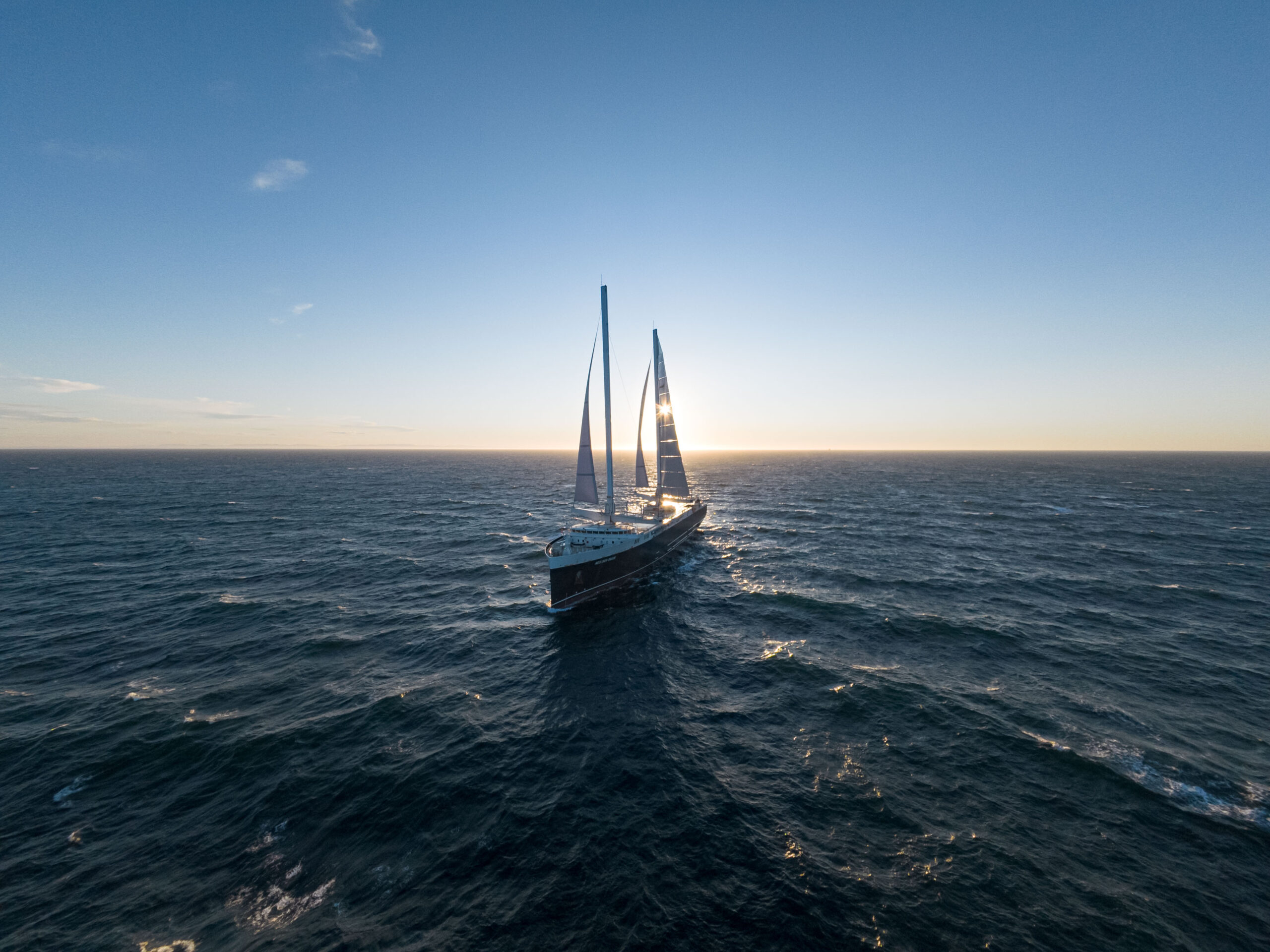
By combining energy efficiency with the use of wind power, Neoliner Origin achieved 70% fuel savings in 2026 compared with comparable vessels listed in the latest GLEC report, transported more than 12,000 tonnes of cargo and added a new port of call in Zeebrugge.
NEOLINE reviews its first year of operations and sets its targets for 2027.
One year after entering service, Neoliner Origin presents its first operational, environmental and commercial results. Despite the technical challenges encountered, the vessel confirms the potential of a shipping model combining wind as its primary means of propulsion, energy efficiency and industrial-scale operations.
Commissioned in October 2025, Neoliner Origin is a 136-metre ro-ro cargo vessel designed to use wind as its primary source of propulsion. It operates a transatlantic route connecting Europe and North America, calling at Montoir-de-Bretagne, Saint-Pierre-et-Miquelon, Baltimore, Halifax and, since September 2026, Zeebrugge.
This first year of operations took place in a demanding environment, inherent to the commissioning of a pioneering vessel and marked by a disrupted transatlantic commercial environment. The service nevertheless demonstrated its ability to meet shippers’ needs, with well-managed loading and transport operations and excellent energy performance.
Neoliner Origin maintained its service throughout the year, covering more than 62,000 nautical miles and completing nine commercial round trips since entering service. It transported nearly 56,000 m³ of cargo, including vehicles, containers, out-of-gauge cargo, industrial machinery and refrigerated goods.
Significant fuel savings from the very first year
According to NEOLINE’s assessment, based on the GLEC (Global Logistics Emissions Council) fleet reference, Neoliner Origin saved 3,502 tonnes of fuel over a full year, representing an average reduction of 66% over the entire period and 70% when considering 2026 alone. These savings also represent 11,228 tonnes of CO? avoided compared with this reference.
To put these results into perspective, NEOLINE also compared the vessel’s fuel consumption with that of an equivalent conventional vessel without sails, simulated over the same routes and operating at 15 knots*. On the routes studied for the relevant 2026 voyages, Neoliner Origin achieved fuel savings of between 62% and 67%**.
Growing commercial activity
Beyond its environmental performance, this first year has demonstrated Neoliner Origin’s ability to carry a wide variety of cargo as part of a commercial transatlantic shipping service.
Based on consolidated commercial data, the vessel transported 1,845 cargo units, representing approximately 12,063 tonnes and 55,889 m³ of cargo.
The year also saw several key milestones in NEOLINE’s commercial development:
- The development of commercial partnerships with CMA CGM and CEVA.
- The expansion of commercial relationships in North America, notably with Montship in Canada, NEOLINE’s partner in this market.
- The opening of the Zeebrugge port of call in September 2026, a strategic new European port of call for ro-ro, automotive and out-of-gauge cargo flows.
The vessel also carried more than 170 passengers during its first year, with strong demand for this transatlantic crossing service. All these developments help demonstrate the industrial and commercial potential of a shipping model incorporating wind propulsion on a large scale.
A new target of 78% fuel savings
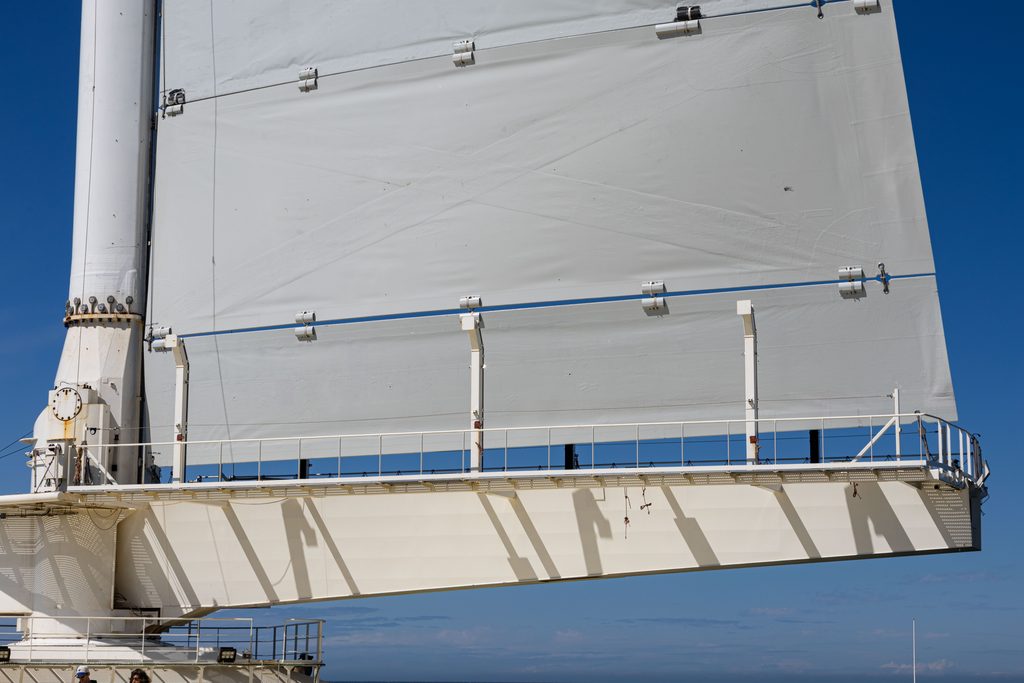
Operating this pioneering vessel has provided essential operational data to better understand the performance of wind propulsion and identify areas for improvement. When the rig is fully operational, Neoliner Origin has demonstrated its ability to regularly sail at over 15 knots under sail alone, reaching a peak speed through the water of 16.6 knots in June 2026 with the engine stopped. However, technical issues affecting the sails have significantly limited their operating time, particularly with all sails deployed. Ongoing efforts to resolve these issues, together with our partner Chantiers de l’Atlantique, will make it possible to significantly increase sail utilisation in 2027 and further reduce the vessel’s environmental impact.
For 2026-2027, NEOLINE has therefore set itself the target of achieving at least a 78% reduction in fuel consumption compared with the GLEC fleet reference. Several actions are planned to achieve this, including a scheduled maintenance period in February 2027 to restore the full use of the SolidSail rig.
“This first year of operations confirms the potential of wind propulsion to significantly reduce fuel consumption and CO? emissions in maritime transport. It has also been challenging, as can be expected when developing a prototype vessel, and has enabled us to draw valuable lessons to improve its performance. NEOLINE also relies on the commitment of our technical and commercial partners and on the trust of our shipping customers who entrust us with their cargo. We would like to thank them for their commitment and support, which are essential to the continued development of this new transport solution. We are confident in our ability to approach, and potentially exceed, 80% fuel savings as early as 2027.” – Jean Zanuttini, Chairman and CEO of NEOLINE
*The average commercial speed of a conventional ro-ro vessel is between 14 and 18 knots.
**The 62% to 67% range reflects a 15% methodological uncertainty related to the consideration of ETA (Estimated Time of Arrival) variations, as the virtual vessel simulations do not yet account for schedule adjustments made during crossings.
About Neoline
Founded in 2015, NEOLINE develops low-carbon shipping solutions based on wind as the primary means of propulsion and energy efficiency. With Neoliner Origin, its first vessel, the company operates a transatlantic shipping service for cargo, combining ro-ro freight, out-of-gauge cargo and containers. NEOLINE aims to help reduce the carbon footprint of supply chains by offering an operational alternative to conventional maritime transport.
Press contacts
Gabriella Paulet – g.paulet@neoline.eu – +33 7 56 42 03 47
Jean Zanuttini – j.zanuttini@neoline.eu – +33 6 74 79 86 44
