
Since entering service in October 2025, Neoliner Origin has completed six transatlantic round trips. No two voyages are alike: each one brings new experiences, unexpected challenges and, sometimes, outstanding performances.
We wanted to share some of these highlights with you, not only to celebrate what the vessel can achieve, but also to demonstrate the potential of primary wind propulsion in commercial shipping.
In late June 2026, after leaving the Chesapeake Bay* on our way to Halifax, the sails once again took centre stage. Following the first part of the voyage from Saint-Nazaire, where wind propulsion had already played a key role, we switched off the engines. For several days, Neoliner Origin, a 136-metre, 11,000-tonne cargo vessel, was propelled almost entirely by its 3,000 m² of sails.
And the results speak for themselves:
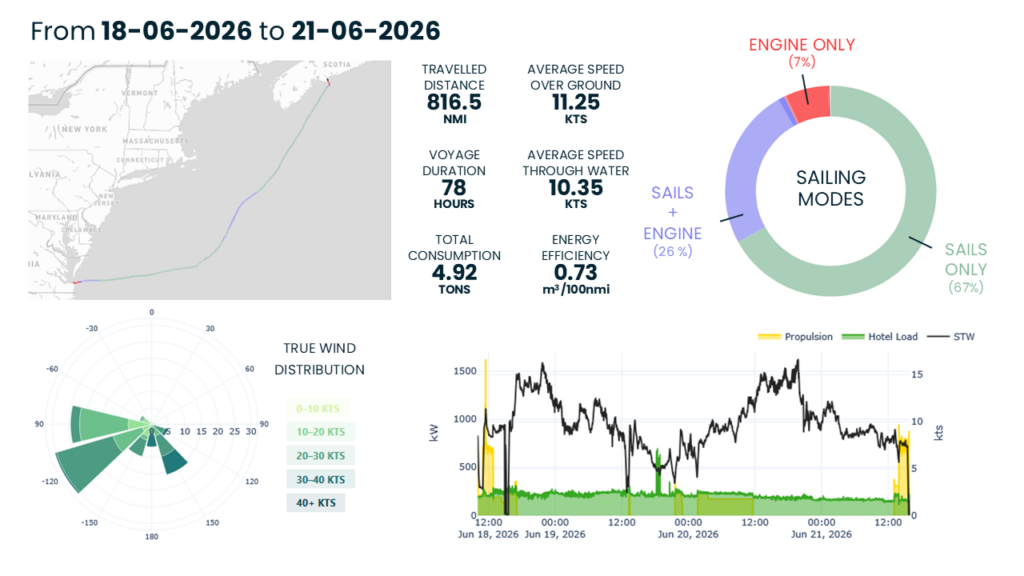
- Peak speed through the water: 16.6 knots, achieved under sail alone, a new record for Neoliner Origin, beating the previous record of 15.5 knots set in March 2026.
- Average speed over ground: 11.2 knots across the entire leg.
- Average commercial speed: 9.3 knots, taking into account the additional distance sailed as a result of wind routing, adjusting the vessel’s course to make the best possible use of the available wind.
- 78% fuel savings on this leg, equivalent to 17 tonnes, compared with an equivalent conventional vessel sailing the same route directly at the same commercial speed of 9.3 knots. In other words, fuel consumption was reduced by a factor of 4.5.
- The comparison becomes even more striking when looking at a conventional vessel operating at its typical commercial speed of 15 knots. By combining the contribution of wind propulsion with the fuel savings achieved by sailing at a lower speed, total fuel savings reached 89%, cutting fuel consumption by a factor of 9 !
Voyage data:
A closer look at the speed record:
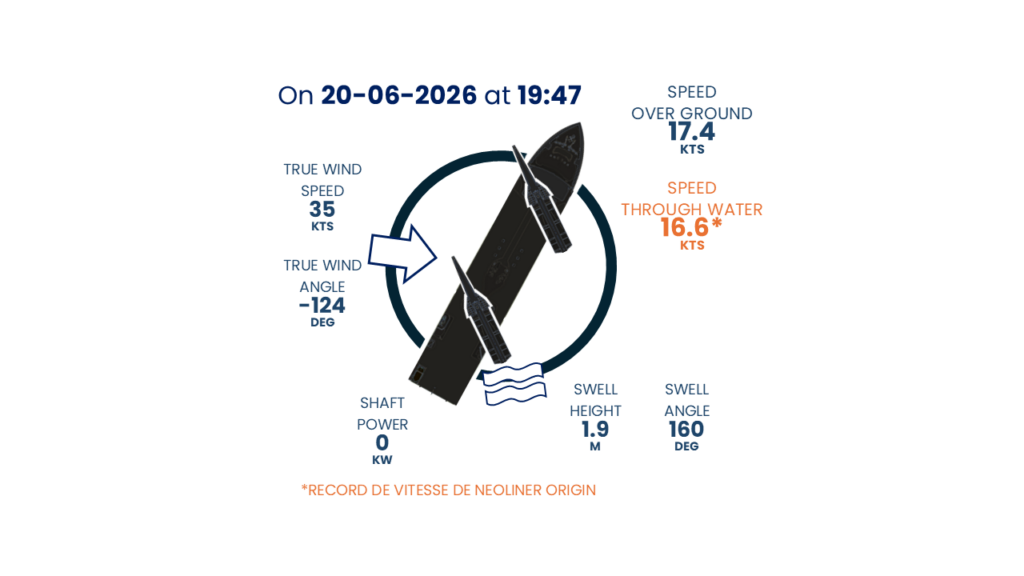
To make sense of these figures, two concepts need to be distinguished:
- Average speed through water: speed relative to the water’s surface (measured by the doppler log), averaged over the whole passage. Under sail alone, it directly reflects the wind’s propulsive force on the sails;
- Average speed over ground: speed relative to the seabed (measured by GPS), averaged over the whole passage, which also factors in the effect of currents.
How the reference fuel consumption of the equivalent motor-only vessel is calculated
Continuously monitored consumption
The ship’s fuel consumption (low-sulphur MGO) is measured continuously while underway, using sensors fitted to the engines and electronic probes in the fuel tanks. This data is then cross-checked at each port call by manually gauging the tanks, to ensure accuracy.
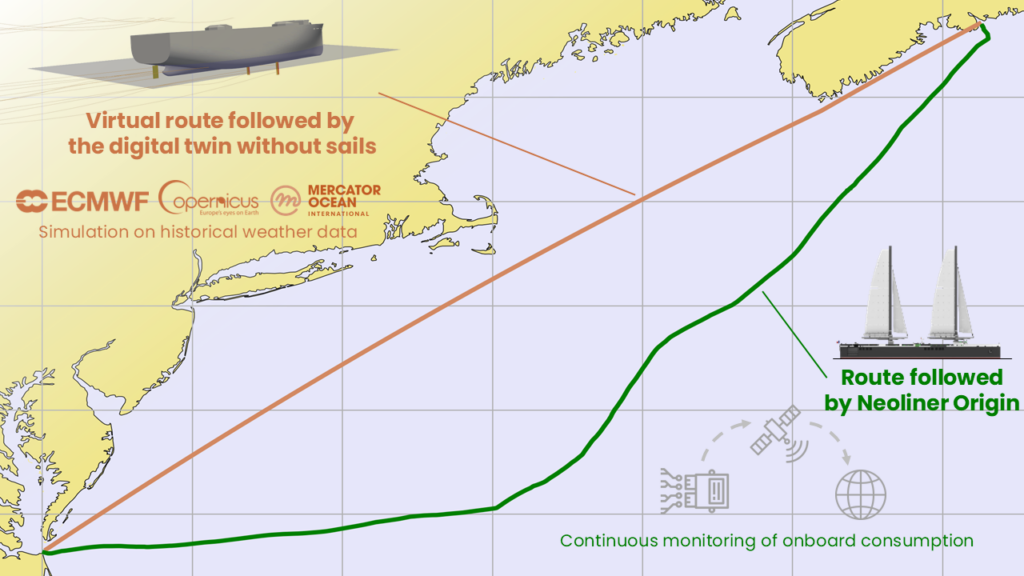
Comparison with a virtual sister ship, without sails
The fuel savings are calculated by comparing our actual consumption with that of a hypothetical vessel, identical to Neoliner Origin in every respect, but without sails. This reference ship departs at the same time from the same port and arrives at the same destination, but doesn’t follow the real ship’s actual track: instead, it takes the theoretical route a conventional vessel would most likely have sailed, hewing as closely as possible to the shortest path between the two points (the great-circle route). It’s then simulated computationally along that route, using historical weather data (wind, waves, currents), to work out how much fuel it would have burned.
A method under continuous improvement
This method necessarily rests on certain choices, particularly regarding the virtual route assigned to the comparison vessel and the theoretical performance data used to simulate it. We’re continually working to refine these inputs, so our calculations stay as close to reality as possible.
–
Congratulations to the crew, whose dedication and drive to bring Neoliner Origin’s sails to life made this performance possible. It’s thanks to their commitment and professionalism that the ship can express its full sailing potential. A big thank you as well to all our partners, who support us on this adventure.
This milestone under sail reminds us why we’re committed to this cause, and encourages us, on land as at sea, to keep pursuing our goals for decarbonising maritime transport.
On that same voyage, on the return leg to Montoir de Bretagne, Neoliner Origin suffered damage to its forward mainsail. The ship was able to resume operations on 13 July, sailing with a reduced rig of 3 sails instead of 4. We’re working with our partners to restore full use of all the sails as quickly as possible, and look forward to delivering more exceptional performances very soon!
*The use of sails is not permitted in the Chesapeake Bay.
